Hello,Welcome to Normal Website!

Service hotline400-6177-880
Hello,Welcome to Normal Website!
Service hotline400-6177-880

Contact US
Tell:+86-571-85691658
Fax:+86-571-28867000
E-mail:[email protected]
Address:North block, 9 block,, Jiangling, Binjiang District, Hangzhou, Zhejiang

Material & Automotive Part

Salt spray test
1. Corrosion caused by salt spray
Corrosion refers to the destruction or deterioration of materials or their properties caused by environmental factors. Most corrosion occurs in the atmospheric environment, which contains corrosive components and factors such as oxygen, humidity, temperature variations, and pollutants. Salt spray corrosion is a common and highly destructive form of atmospheric corrosion. The salt spray referred to here refers to an atmosphere containing chlorides, with the main corrosive component being sodium chloride, a salt found in the ocean and in salt-affected areas inland. The corrosion of metal material surfaces by salt spray is caused by the penetration of chloride ions through the oxide and protective layers on the metal surface, leading to electrochemical reactions with the internal metal. At the same time, chloride ions possess a certain hydration energy, making them easily adsorbed into pores and cracks on the metal surface, displacing oxygen in the chloride layer, converting insoluble oxides into soluble chlorides, and transforming the passivated surface into an active one. This results in extremely adverse effects on products.
II. Salt spray test and its relevance to reality
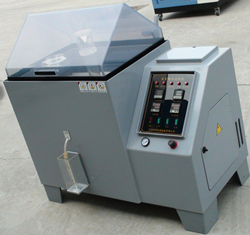
The salt spray test is an environmental test that primarily utilizes artificial simulated salt spray environmental conditions created by salt spray test equipment to assess the corrosion resistance of products or metal materials. It is divided into two major categories: natural environment exposure tests and artificial accelerated simulated salt spray environmental tests. The artificial simulated salt spray environmental test utilizes a test equipment with a certain volume space - the salt spray test chamber - to artificially create a salt spray environment within its volume space to assess the quality of the product's salt spray corrosion resistance. Compared to natural environments, the salt spray environment in artificial simulated salt spray environmental tests has a chloride salt concentration that can be several times or even dozens of times higher than the salt spray content in general natural environments, greatly increasing the corrosion rate. The time required to obtain results from a salt spray test on a product is also significantly shortened. For example, testing a product sample in a natural exposure environment may take up to one year for corrosion to occur, while testing under artificial simulated salt spray environmental conditions can yield similar results in just 24 hours.
The artificial simulated salt spray test includes neutral salt spray test, acetic acid salt spray test, copper salt accelerated acetic acid salt spray test, and alternating salt spray test.
(1) The neutral salt spray test (NSS test) is one of the earliest and most widely used accelerated corrosion test methods. It employs a 5% sodium chloride aqueous solution with a pH value adjusted to the neutral range (6-7) as the solution for spraying. The test temperature is uniformly set at 35℃, and the salt spray deposition rate is required to be between 1-2ml/2000px2.h.
(2) The Acetic Acid Salt Spray Test (ASS Test) is developed on the basis of the Neutral Salt Spray Test. It involves adding some glacial acetic acid to a 5% sodium chloride solution to reduce the pH value of the solution to around 3, turning it acidic. As a result, the salt spray formed also changes from neutral to acidic. Its corrosion rate is about three times faster than that of the NSS Test.
(3) The Copper Accelerated Acetic Acid Salt Spray (CASS) test is a recently developed rapid salt spray corrosion test internationally. The test temperature is 50℃, and a small amount of copper salt - copper chloride is added to the salt solution to strongly induce corrosion. Its corrosion rate is approximately 8 times that of the NSS test.
(4) The alternating salt spray test is a comprehensive salt spray test, which is actually a combination of a neutral salt spray test and a constant damp heat test. It is primarily used for cavity-type complete products, allowing salt spray corrosion to occur not only on the surface of the product but also inside through the infiltration of moisture-laden environment. It involves alternating the product between salt spray and damp heat environments, and ultimately assessing whether there are any changes in the electrical and mechanical properties of the complete product.
III. Salt spray test standards and determination of test results
Standards are unified regulations for repetitive matters and general descriptions. Salt spray test standards provide specific and clear regulations for salt spray test conditions, such as temperature, humidity, sodium chloride solution concentration, and pH value. Additionally, they set technical requirements for the performance of salt spray test chambers. The selection of salt spray test standards for a particular product depends on the characteristics of the salt spray test, the corrosion rate of the metal, and its sensitivity to salt spray. Below are several examples of salt spray test standards: GB/T2423.17—1993 "Basic Environmental Testing Procedures for Electric and Electronic Products - Test Ka: Salt Spray Test Method", GB/T2423.18—2000 "Environmental Testing for Electric and Electronic Products - Part 2: Tests - Test Kb: Salt Spray, Cyclic (Sodium Chloride Solution)", GB5938—86 "Corrosion Resistance Test Method for Metal Coatings and Chemical Treatment Layers of Light Industrial Products", and GB/T1771—91 "Determination of Resistance to Neutral Salt Spray of Paints and Varnishes".
The purpose of the salt spray test is to assess the resistance of products or metal materials to salt spray corrosion. The judgment of salt spray test results is a verdict on product quality, and whether its judgment results are correct and reasonable is the key to accurately measuring the resistance of products or metals to salt spray corrosion. The methods for judging salt spray test results include: rating judgment method, weighing judgment method, appearance of corrosion product judgment method, and statistical analysis of corrosion data method. The rating judgment method divides the percentage of corrosion area to total area into several levels according to a certain method, and uses a certain level as the basis for qualification judgment. It is suitable for evaluating flat samples. The weighing judgment method evaluates the corrosion resistance quality of samples by weighing the samples before and after the corrosion test to calculate the weight loss due to corrosion. It is particularly suitable for assessing the corrosion resistance quality of a certain metal. The appearance of corrosion product judgment method is a qualitative judgment method that judges samples based on whether corrosion occurs after the salt spray corrosion test. This method is generally adopted in most product standards. The statistical analysis of corrosion data method provides methods for designing corrosion tests, analyzing corrosion data, and determining the confidence level of corrosion data. It is mainly used for analyzing and statistically evaluating corrosion conditions, rather than specifically for quality judgment of a specific product.
1 GB/T 10125-1997 Corrosion Testing in Artificial Atmosphere - Salt Spray Test
2 GB/T 10263.7-1988 Basic Requirements and Methods for Environmental Testing of Radiation Detectors - Salt Spray Test
3 GB/T 10587-1989 Technical Conditions for Salt Spray Test Chamber
4 GB/T 10593.2-1990 Measurement Methods for Environmental Parameters of Electric and Electronic Products - Salt Spray
5 GB/T 11606.13-1989 Environmental Testing Methods for Analytical Instruments - Salt Spray Test
6 GB/T 12000-2003 Determination of the effects of exposure to damp heat, water spray, and salt spray on plastics
7 GB/T 12085.4-1989 Optics and Optical Instruments - Environmental Test Methods - Salt Spray
8 GB/T 12967.3-1991 Anodizing of Aluminum and Aluminum Alloys - Copper Accelerated Acetic Acid Salt Spray Test (CASS Test) for Anodic Oxide Coatings
9 GB/T 1765-1979 Method for Preparing Paint Films for Determining Resistance to Damp Heat, Salt Spray, and Weatherability (Artificial Acceleration)
10 GB/T 1771-1991 Paints and Varnishes - Determination of Resistance to Neutral Salt Spray
11 GB/T 18310.26-2003 Fibre optic interconnecting devices and passive components - Basic test and measurement procedures - Part 2-26: Tests - Salt spray
12 GB/T 18912-2002 Photovoltaic Modules - Salt Spray Corrosion Test
13 GB/T 2423.17-1993 Basic Environmental Testing Procedures for Electric and Electronic Products - Test Ka: Salt Spray Test Method
14 GB/T 2423.18-2000 Environmental Testing for Electric and Electronic Products - Part 2: Tests - Test Kb: Salt Spray, Cyclic (Sodium Chloride Solution)
15 GB/T 4797.6-1995 Environmental conditions for electric and electronic products - Dust, sand, salt spray
16 GB/T 5170.8-1996 Verification Method for Basic Parameters of Environmental Testing Equipment for Electric and Electronic Products - Salt Spray Testing Equipment
17 GB/T 2423.17-1993 Basic Environmental Testing Procedures for Electric and Electronic Products - Test Ka: Salt Spray Test Method
Please consult NormalTCI for specific questions
National Unified Service Hotline: 400-6177-880
Email: [email protected]
Copyright @ 2015 NORMAL (HANGZHOU) TESTING & CERTIFICATION CO., LTD.
Tell:+86-571-28906690 E-mail:[email protected] Service Hotline:400-6177-880 Fax:+86-571-28867000
If you have any comments on the website, please email to:[email protected]